
Best Air Purifier for Bedroom: 3 HEPA Models Compared
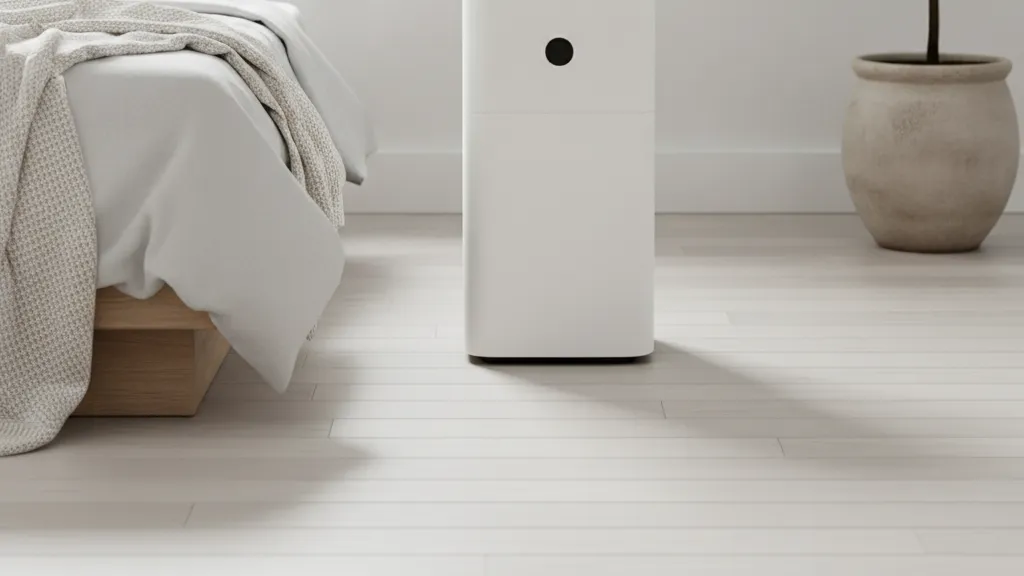
The bedroom is where most of us spend the longest uninterrupted stretch of the day, so the air in that room deserves deliberate attention. A well-chosen air purifier is designed to capture airborne particles such as dust, pollen and pet dander while running quietly through the night.
This guide compares three HEPA air purifiers using only their published specifications: the Levoit Core 300-P, the PuroAir HEPA Air Purifier and the MOOKA Air Purifier with PM2.5 Sensor. We look at verified performance data, sleep-mode noise, light control, filtration stages and upkeep, so you can match a unit to your room and your priorities.
If you have asthma, allergies or another respiratory condition, an air purifier is not a substitute for medical care. Speak with your doctor about how air quality fits into your overall plan.
Quick picks
| Product | Best for | |
|---|---|---|
| Levoit Core 300-P True HEPA Air Purifier | Small to mid-size bedrooms where verified performance data, a compact size and a dark, quiet night setting are priorities. | View |
| PuroAir HEPA Air Purifier (Large Rooms) | Large bedrooms or suites where hands-off automatic operation and carbon filtration matter more than detailed verified specs. | View |
| MOOKA Air Purifier with PM2.5 Sensor | Light sleepers who want the lowest published noise level and real-time air quality feedback in the bedroom. | View |
What Matters Most in a Bedroom Air Purifier
Bedroom use places different demands on a purifier than a living room does. The unit needs enough cleaning capacity for the room, but it also has to run for hours while you sleep without noise or light becoming a distraction.
The most useful specifications are the Clean Air Delivery Rate (CADR), the rated room size or air changes per hour, the sleep-mode noise level, whether display lights can be turned off, and the filtration stages. Of the three models here, only the Levoit publishes CADR figures, which makes direct performance comparisons more difficult.
Understanding CADR and Room Coverage
CADR expresses how much filtered air a purifier delivers, measured in cubic feet per minute. The Levoit Core 300-P lists 143 CFM for smoke, 153 CFM for dust and 167 CFM for pollen, and states 4.8 air changes per hour in a 222 sq ft room. Its performance is AHAM Verifide, meaning AHAM, an ANSI-accredited organization, independently tests air-cleaning performance and energy efficiency.
PuroAir gives coverage figures rather than CADR, and they differ within the listing: the title cites up to 1,115 sq ft, while a bullet cites up to 1,000 sq ft cleaned in one hour. MOOKA does not state a CADR or room-size rating in its bullets. When a figure is missing, it is reasonable to weigh the verified data you do have more heavily.
Noise, Light and Sleep-Friendly Design
For overnight use, a published sleep-mode decibel figure is helpful. MOOKA lists a sleep mode as low as 20 dB with lights off, and Levoit lists a sleep mode down to 24 dB with display lights that can be turned off. PuroAir describes a built-in quiet sleep mode but does not publish a decibel figure.
Timers can also be useful in a bedroom. Both Levoit and MOOKA offer 2, 4, 6 or 8-hour timers, while PuroAir is described as designed for 24/7 use.
Filtration Stages, Sensors and Ozone
All three models use HEPA filtration. PuroAir and MOOKA add an activated carbon stage, which is intended for odors and, in PuroAir's case, VOCs per the brand. MOOKA also uses a washable pre-filter. The Levoit listing highlights its HEPA-grade filter and does not describe a carbon stage.
PuroAir and MOOKA include particle sensors that raise fan speed automatically when pollution is detected, and MOOKA shows PM2.5 readings on a real-time display. MOOKA states that it produces no ozone and uses no UV light. All three list CARB certification or compliance, the California standard related to ozone emissions from air cleaners.
Maintenance and Long-Term Ownership
Filter replacement is the main ongoing commitment. Levoit includes a check-filter indicator and recommends official Levoit replacement filters. MOOKA provides a filter reminder after 2,000 hours and recommends official MOOKA filters, and its pre-filter is washable.
Support terms vary. PuroAir lists a 2-year warranty, while MOOKA lists 60-day returns, a 2-year exchange and lifetime technical support. MOOKA also notes that the plastic bag must be removed from the filter before first use.
Levoit Core 300-P True HEPA Air Purifier
A compact, verified performer and the only model here with published CADR figures. It lists 143 CFM for smoke, 153 CFM for dust and 167 CFM for pollen, with 4.8 air changes per hour in a 222 sq ft room, which makes it a well-documented fit for a typical bedroom. Its sleep mode runs down to 24 dB, display lights can be turned off, and its filter is listed as HEPA-grade with 99.97% efficiency for particles from 0.1 to 0.3 μm, per an independent lab cited in the listing.
- AHAM Verifide performance with published CADR for smoke, dust and pollen
- 4.8 air changes per hour in a 222 sq ft room
- Sleep mode down to 24 dB with display lights that can be turned off
- Compact footprint at 8.7 x 8.7 x 14.2 in and 7.9 lb
- 2, 4, 6 or 8-hour timer and check-filter indicator
- No particle sensor or auto mode described in the listing
- No activated carbon stage described
- 120 V, for use in the US only, and official Levoit filters are recommended
Best for: Small to mid-size bedrooms where verified performance data, a compact size and a dark, quiet night setting are priorities.
Check price on AmazonPuroAir HEPA Air Purifier (Large Rooms)
A larger-room purifier with three-layer filtration (pre-filter, HEPA and activated carbon) and a smart particle sensor that increases fan speed when pollution is detected. It is designed for 24/7 use and includes a quiet sleep mode. Coverage is stated as up to 1,115 sq ft in the title and up to 1,000 sq ft in one hour elsewhere in the listing, so it suits large primary bedrooms or open-plan sleeping spaces.
- Three-layer filtration including activated carbon for odors and VOCs, per the brand
- Smart particle sensor with automatic fan-speed adjustment
- Designed for continuous 24/7 operation with a sleep mode
- CARB, ETL, ISO and UL certifications listed
- 2-year warranty from a US-based company, per the listing
- No CADR figure published
- Coverage and filtration figures are inconsistent within the listing
- Sleep mode has no published decibel level
Best for: Large bedrooms or suites where hands-off automatic operation and carbon filtration matter more than detailed verified specs.
Check price on AmazonMOOKA Air Purifier with PM2.5 Sensor
A feature-rich bedroom option with a PM2.5 sensor and real-time display, an auto mode, and the quietest published sleep setting in this group at as low as 20 dB with lights off. Its three-stage filtration combines a washable pre-filter, HEPA filter and activated carbon pellets, and it draws air through a dual-sided intake. The listing reports 0.63 kWh for 24 hours at maximum speed and states no ozone and no UV light.
- Sleep mode as low as 20 dB with lights off
- PM2.5 sensor with real-time display and auto mode
- Washable pre-filter plus HEPA and activated carbon
- No ozone and no UV light, per the listing; CARB, ETL and DOE certified
- Child lock, 4 fan speeds and 2/4/6/8-hour timer
- No CADR or room-size rating stated in the listing bullets
- Filter reminder at 2,000 hours, with official MOOKA filters recommended
- Aromatherapy pad may not suit people sensitive to scents; consult a doctor if fragrance is a concern
Best for: Light sleepers who want the lowest published noise level and real-time air quality feedback in the bedroom.
Check price on AmazonFAQ
What size air purifier do I need for a bedroom?
Match the unit's rated capacity to your room's square footage. The Levoit Core 300-P, for example, lists 4.8 air changes per hour in a 222 sq ft room, a useful reference point for an average bedroom.
Is it safe to run an air purifier all night?
These models are built with sleep modes and timers for overnight use, and PuroAir is described as designed for 24/7 operation. Follow the manufacturer's instructions and replace filters as recommended.
Can an air purifier help with allergies?
HEPA purifiers are designed to capture airborne particles such as pollen, dust and pet dander, which may support a cleaner indoor environment. They do not treat allergies, so consult your doctor about managing symptoms.
Do I need activated carbon in a bedroom purifier?
Activated carbon is intended for odors and, according to some brands, VOCs. PuroAir and MOOKA include a carbon stage; the Levoit listing focuses on its HEPA-grade filter.
Bottom line
For most standard bedrooms, the Levoit Core 300-P offers the clearest picture of performance, with AHAM Verifide CADR figures, a 24 dB sleep mode and a compact footprint. The MOOKA is a strong choice for light sleepers who value a 20 dB sleep mode and real-time PM2.5 readings, while the PuroAir suits larger bedrooms where automatic operation and carbon filtration are priorities.
Whichever you choose, size the purifier to your room, keep up with filter changes and treat cleaner air as one part of a broader approach to rest and health. If you have a respiratory condition, talk with your doctor about the role an air purifier may play for you. Check Amazon for current pricing and availability.